Sean Rusk
Needful ThingsSean Rusk is the seven-year-old younger brother of Brian Rusk and a crucial witness to the forces that draw his brother into danger. After Brian dies by suicide, Sean tells Alan Pangborn what he saw and recalls the promise Brian made him keep: never to visit Needful Things, where Brian acquired the baseball card that had taken hold of his life. His testimony links the apparently trivial card to Brian’s escalating distress and reveals Brian’s warning about Leland Gaunt.
Family and Background
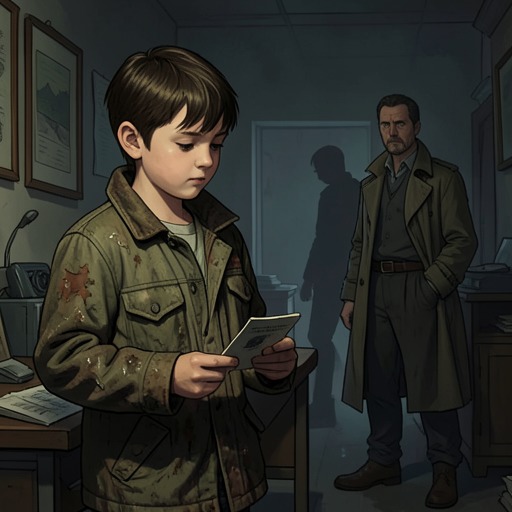
Sean lives with his family and is younger than Brian, whose behavior has frightened him during the week leading up to the crisis. From his bedroom window, Sean sees Brian go into the garage carrying something, and recognizes it as the old baseball card Brian had been privately examining. Sean has already sneaked into Brian’s room to look at it himself. It is worn and faded, and its player is not the famous Sandy Koufax Brian apparently believes it to be, but an obscure pitcher Sean has never heard of. The contrast between the card’s unimpressive appearance and the power it holds over Brian is central to Sean’s understanding of the change in his brother.
Sean cannot explain why the card matters so much. He notices, however, that Brian has seemed frighteningly unlike himself for about a week, and wonders whether drugs could account for the change. His uncertainty is that of a child trying to interpret an abrupt crisis with limited information: he recognizes the danger in Brian’s behavior but does not yet know its source.
Witness to Brian’s Crisis
When Brian does not come back out of the garage, Sean’s unease grows until he goes to look for him. He finds Brian there with their father’s rifle and the card. Sean calls out, but Brian tells him not to come closer. The scene makes Sean both the person most directly exposed to Brian’s final crisis and the witness who will later have to describe it.
Brian dies by suicide in the garage, and Sean sees it happen. The experience is not presented as something he can readily absorb: when Alan later speaks with him in the pediatric wing, Sean appears pale and composed, but the account makes clear that he has been through a severe shock. He tells Alan plainly that he saw Brian kill himself. Alan responds with sympathy rather than pressing him to treat the death as an ordinary explanation for the card’s importance.
The consequences for Sean include a stay in hospital and a tranquilizer; a staff member tells Alan that the boy is stirring but will not be fully awake for some time. Alan asks repeatedly to speak with him, making clear that he believes the child’s information matters. Sean’s age and condition are also recognized as reasons for caution: the staff member initially refuses access because he is only seven. Once Sean is able to speak, he is calm, but his fear surfaces when the conversation turns to the card.
The Card and the Warning
Sean explains that Brian and he had enjoyed watching western films together before Brian got the card. His recollection gives their shared interest a before-and-after shape: the card marks the point at which Brian’s behavior and their familiar routine changed. Sean also knows Brian thought the card showed Sandy Koufax, although it actually featured another player. Brian had made Sean promise never to go to the new store where he got it. The promise turns an apparently private purchase into a warning about a place and a danger Brian could not fully explain.
Sean remembers another detail: Brian came home with mud on his hands, washed them, and later cried in his room. Alan connects this to the mud prank Brian had carried out against Wilma Jerzyck, recognizing the act behind Brian’s remorse. Sean does not supply that identification himself; his memory gives Alan the concrete clue that allows him to understand what Brian had done and why he had been upset afterward.
Brian also told Sean that Mr. Gaunt was not really a man. Sean’s testimony therefore does more than clarify the card’s effect or the events immediately preceding Brian’s death. It brings Alan a direct warning about Gaunt’s nature, helping turn the investigation from a local boy’s unexplained fixation toward the threat associated with the shop.
Relationship to Alan Pangborn and Narrative Role
Alan Pangborn approaches Sean as a grieving father as well as the sheriff seeking answers. Alan’s own thoughts return to the deaths of his wife, Annie, and son, Todd. He remains troubled by the circumstances of their car crash, especially the unanswered question of whether Todd was still alive when the vehicle’s gas tank exploded. Sean’s ordeal thus intersects with Alan’s unresolved grief, but Alan does not make the children’s experiences interchangeable: he seeks permission to speak with Sean and listens to the boy’s account as testimony about Brian and Gaunt.
Sean’s importance lies in what he can witness and remember, not in any ability to explain the supernatural bargain that drew Brian in. The card looks worthless to him; its hold over Brian is baffling; and Brian’s warning is delivered without a full account of what Gaunt is. Those gaps preserve Sean’s limited, child’s-eye knowledge while giving his testimony decisive force. His memory exposes the connection between the shop, the card, Brian’s frightening change, and the larger danger Alan is trying to confront.